With seven artisan cocktails crafted with 11 Kansas City-based spirits, the Founders’ Lounge at the Kauffman Center redefines the cocktail experience by featuring the finest creations from local distilleries. Formerly known as The Dining Experience, the Founders’ Lounge is located just within the south doors and serves as the on-site restaurant at the Kauffman Center.
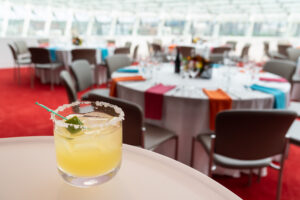
Photo by Don Ipock
The Kauffman Center is proud to partner with Tom’s Town Distilling Co., J. Rieger & Co. and Restless Spirits Distilling Company. These distilleries represent Kansas City’s spirited history with beginnings dating back as early as 1853 and as recent as 2016.
“Five or six years ago, I started taking note of the distilleries here in Kansas City. I noticed a uniqueness from each distiller,” said Founders’ Lounge Dining Manager Kevin Fossland. “Fast forward to joining the Kauffman Center team, I had the desire to build relationships with local products. The Kauffman Center for the Performing Arts is a Kansas City landmark, so it seems more than natural for it to be a platform for Kansas City endeavors.”
The Founders’ Lounge menu uses these three distilleries in five of its seven perfectly crafted cocktails: Welcome to Kauffman and Bee’s Knees (with your choice of Kansas City gin), Kansas City Old Fashioned (with your choice of Kansas City whiskey), Missouri Mule (with your choice of Kansas City vodka) and the Negroni (with Tom’s Town Garden Party).
Restless Spirits Distilling Company
Although a newcomer to Kansas City’s distilling scene in 2014, Restless Spirits is the realization of a dream that has been brewing for over 150 years. Its founders, the Shannon Family, were some of Kansas City’s earliest Irish settlers in 1853. Today, the Kauffman Center offers these Restless Spirits products: Builders Barrel Finished (gin), Builders (gin), Stone Breaker (whiskey), Gully Town Single Malt (whiskey) and Duffy’s Run (vodka).

Photo by Anna Petrow
Founded in 1887, J. Rieger & Co. has been a Kansas City staple from the days of pre-Prohibition to the revival of craft spirits in the modern age. With over a century of craftmanship, its continued relevance mirrors the innovative spirit of Kansas City. The Kauffman Center offers these J. Rieger & Co. products: Midwestern (gin), Kansas City (whiskey) and Premium Wheat (vodka).
Recognized as downtown Kansas City’s first legal distillery since Prohibition, Tom’s Town pays homage to an era of speakeasies and jazz with a name that references Prohibition-era boss, Tom Pendergast. Tom’s Town opened in 2016 and continues to satisfy Kansas City locals. The Kauffman Center offers these Tom’s Town classics: Garden Party (gin), Botanical (gin), Royal Gold Bourbon (whiskey) and Double Grain (vodka).
Other Local Spirits
At the Kauffman Center, patrons may also enjoy select products from any of the following Kansas City-based spirits: ANNX Spirits Co., Boozy Botanicals, Holladay Distillery, Lifted Spirits Distillery, Of The Earth Farm Distillery, Somerset Ridge Vineyard and Winery, Union Horse Distilling Co. and West Bottoms Whiskey Co.
Interested in sampling these local concoctions? Book your reservation today at kauffmancenter.org/dining.
Get Ready for Showtime with Pre-Show Educational Opportunities
Before attending any show, it is important to know what awaits you. This extends not only to the performance itself, but also to the spectacular performers involved. Whether you are planning to enjoy the elegance of the Kansas City Ballet, the theatrical work of the Lyric Opera of Kansas City or the beautiful music of the Kansas City Symphony, here is a list of opportunities to enhance your viewing experience at the Kauffman Center for the Performing Arts, which serves as the home venue for these esteemed companies.
Kansas City Ballet
Unlock the secrets of stage magic and learn how music, special effects and costumes all play a role when you attend a pre-curtain talk, also known as the Belger Footnotes Series, hosted by Artistic Director Devon Carney. Held one hour before the show in the Muriel Kauffman Theatre, ticketholders are free to join without a reservation.
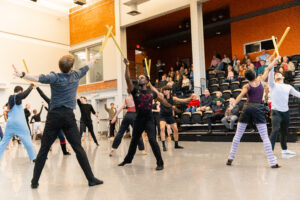
Photo by Kansas City Ballet
Engage with the professional dancers when you attend Dance Speaks and Dancer Chat events, as a part of their pre-performance educational program, Artist Conversations. Locations vary for Dance Speaks events, and all Dance Chats are held virtually on Facebook Live.
Coming up, Dancer Chat: New Moves will be held from 6:30-7:15 p.m. March 13 on Facebook Live, and Dance Speaks: New Voices, New Moves will be held from 6:30-7:30 p.m. March 6 (location to be announced). Learn more here.
Finally, visit the performance page and select any production to find program notes, casting rosters, story synopses and more.

Photo provided by Lyric Opera of Kansas City
Lyric Opera of Kansas City
Held in the Muriel Kauffman Theatre, pre-opera talks are a must for the curious ticketholder. Simply arrive fifty minutes early to get a complete overview of the production you are about to see.
Soon Roméo et Juliette will take the stage at the Kauffman Center. Arrive early to hear Italian conductor, opera coach and composer Dr. Raffaele Cipriano deliver a pre-opera talks from 6:40-7 p.m. March 9 and 15, or from 1:10-1:30 p.m. March 17. Purchase tickets for Roméo et Juliette here.
For additional details on any Lyric Opera event or production, view their Upcoming Events page and start planning your next visit to one of many extraordinary performances.
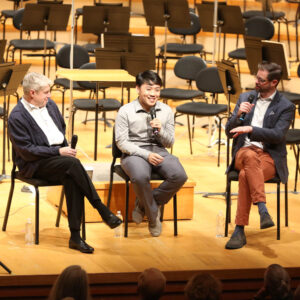
Photo provided by Kansas City Symphony
Kansas City Symphony
Next time you join us in Helzberg Hall for an upcoming classical concert, remember to come one hour before each Kansas City Symphony Classical Series performance to hear G. Kenneth and Ann Baum Concert Comments. Learn more here.
With Music Director Michael Stern or Executive Director Danny Beckley as hosts, these pre-show insights promise to be lively and informative — often featuring that evening’s guest artist.
Future performances offering Concert Comments include Joy Yang Plays Tchaikovsky on March 1, 2 and 3, as well as Matthias Pintscher Welcomes Violinist Philippe Quint on March 22, 23 and 24. Purchase tickets to the next Symphony events here.
Please note that Concert Comments are not held prior to concerts featuring the Kansas City Symphony Chorus.
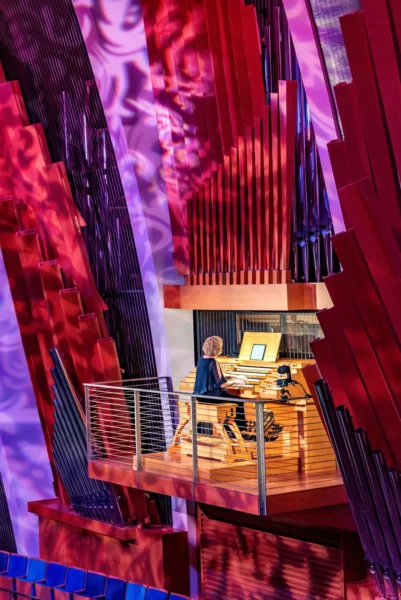
Photo by Roy Inman
Super Bowl Superstitions and a Free Organ Concert
The centerpiece of Helzberg Hall, the Julia Irene Kauffman Casavant Organ, Opus 3875, is so special it has its own conservator. GRAMMY-nominated artist Jan Kraybill has been playing and advocating for the organ since the Kauffman Center opened in 2011. Kraybill herself, however, is also a fascinating subject. She is an international concert organist, pianist and harpsichordist; a dynamic speaker, educator, church musician and has hosted a free organ concert on Super Bowl Sunday for the last 24 years. In anticipation of this Sunday’s Super Bowl, the Kauffman Center asked Kraybill a few questions about herself.
Can you describe your first European piano recital?
I was very fortunate to get to spend the summer living with a family in England when I was a junior in high school. My experiences there opened my eyes in many ways to the much wider world, and awakened in me a love of travel, which I’m happy to say is now a regular part of my professional life! Part of the deal, when this was proposed to my parents, was that I keep up my practicing while there and that there would be performance opportunities. I was grateful to be able to play a solo concert in Andover, England.
How do audiences in different countries regard the organ?
Just like in the U.S., people bring a variety of experiences and impressions of the organ as an instrument. Some have heard it played only at funerals or weddings. Some have heard it as part of a baseball game. Some are lifelong fans of classical organ concerts. Some sing hymns with it every Sunday in church. Some love it as part of their favorite jazz or rock bands. Some have never heard this instrument. What I try to do is bridge all of those impressions when designing my performances, giving people something that is familiar, while expanding boundaries of what the organ and organists can do.
“It’s become a tradition, and I do have to say that the last two times I played this concert for an in-person audience, the Chiefs won the Super Bowl. (My performances had to go online for two years between those wins, due to COVID concerns, and the Chiefs were not victorious.) So I believe this concert tradition is part of their good-luck charms!”
With all the places you’ve traveled, why have you chosen Kansas City as your home?
Basically, because of life circumstances, Kansas City chose me! Earlier in my career, my aim was to move to one or the other of the coasts to “make it.“ I’m so glad that I stayed in Kansas City! The arts scene here is so supportive, diverse and vibrant, and, of course, our beautiful Kauffman Center for the Performing Arts has raised the bar for all of us who live and perform here, in addition to attracting international talent to our city. I’m so grateful to the donors who made this venue possible and to the staff and volunteers who continue to make it active and beautiful.
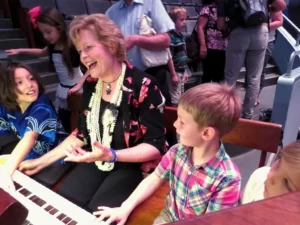
You enjoy many activities outside of your work with organs. Can you tell us about your lace-making hobby?
It’s true, I have a hard time sitting still, so I enjoy many creative outlets. When I was a child, my grandmother and mother taught me how to do the kind of lace-making called tatting. It’s a wonderfully relaxing hobby, a way to create beautiful gifts, and easy to take with me on airplanes.
Tell us about your 25th annual Super Bowl Sunday Organ Concert
I can’t believe I’ve been doing this for a quarter century! It’s become a tradition, and I do have to say that the last two times I played this concert for an in-person audience, the Chiefs won the Super Bowl. (My performances had to go online for two years between those wins, due to COVID concerns, and the Chiefs were not victorious.) So I believe this concert tradition is part of their good-luck charms! This year, my theme is “Most Valuable Players.” I’ll begin the concert with a piece in honor of our KC Chiefs, as I always do when they are in the Super Bowl. I’ll follow that with works representing MVPs of the classical and organ musical worlds. One of those is also in honor of Chiefs kicker Harrison Butker: it opens with 3-1/2 pages of notes played by feet alone!
Concert kickoff is 2 p.m. Sunday, Feb. 11, at Community of Christ Temple. We’ll conclude by 3:30 p.m., prior to Super Bowl kickoff at 5:30 p.m. There will be free parking and free admission. Everyone is encouraged to wear Chiefs’ red and dress as casually as you’d like. Cameras will show live close-up views of my hands and feet in action, projected for the audience’s enjoyment. I’ve been loving rehearsing for this event, and I can’t wait to share it with everyone there!
Make plans to attend Kraybill’s Super Bowl Concert at her website jankraybill.com.
Join the Adventure with Trailblazing Talks
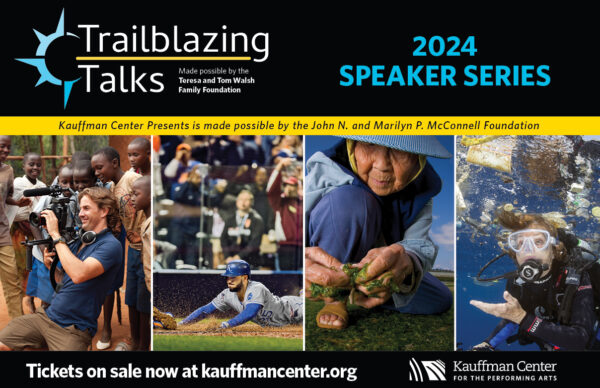
The Kauffman Center is pleased to guide patrons through a journey of exploration with our 2024 series of adventure speakers, Trailblazing Talks. New this year, Trailblazing Talks includes a lineup of renowned presenters whose work reveals fascinating insights about our planet. Join us once a month to learn about mankind and our role on this planet.

Michael Davie, journalist presents Documenting the Red Zone Tuesday, Feb. 20. Photo by Brent Stirton.
In February, witness the power of the human spirit in the most surprising places, inside a South African prison, on a mountainside in Rwanda and on the banks of the Ganges River, to name a few. Documentary filmmaker Michael Davie takes you on an odyssey through his nearly 30-year career, working in war zones, refugee camps and hostile territories.
Join us on March 12 as one of the few women to cover the Majors photographer, Jean Fruth shares a fresh perspective on America’s favorite pastime. Drawing on her extensive interviews with baseball legends, the all-women league that inspired the film A League of Their Own and the trailblazers of today, she paints a vivid picture of the sport’s rich history and exciting future.
Photographer David McLain takes us on a journey of a life well-lived as he uncovers the secrets of the Blue Zones, places where people live vibrant lives beyond 100.
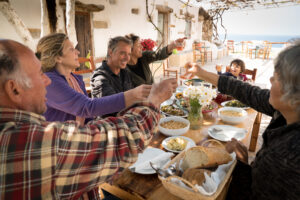
David McLain, photographer, shares The Blue Zones: Unlocking the Secrets of Longevity presents Tuesday, April 23. Photo by David McLain.
McLain has spent years studying the habits of centenarians across the globe. This April, through personal anecdotes and scientific research, David shares how adopting their practices can add quality years to our own lives.
Finally in May, immerse yourself in Dr. Sylvia Earle’s inspiring mission to save the ocean, one “Hope Spot” at a time. Working beyond borders and ideologies, Earle advises heads of state on critical marine protection legislation and crisis response. She strives to help the rest of us navigate the consequences of everything we put into, and take out of, the ocean.
Trailblazing Talks is curated by Changemaker Talent. This speaker series brings to Kansas City a program of thought leaders, celebrated explorers, award-winning journalists, photographers and filmmakers, innovators and artists who are actively engaged in creating a better tomorrow. One by one, they are striving to solve big problems, inspire environmental stewardship, document the world around us and bridge the distance between us. In short, they are changing the world, one story at a time.
Single tickets can be purchased at kauffmancenter.org.
Youth in the Community Show Their Support
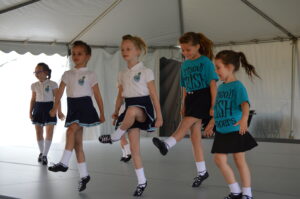
Driscoll School of Irish Dance performs at Future Stages Festival | Photo by Sara Unrein
Have you ever received a gift from a child? Perhaps it was a picture they put their heart and soul into or a chocolate bar they spent their life savings on? One thing is for sure: a gift from a kid, no matter the size, has a memorable impact and contagious positivity. This influence was felt when the Kauffman Center received a surprise donation from youth in the Driscoll School of Irish Dance.
The Driscoll School of Irish Dance made their first appearance at Future Stages Festival in summer 2023. This annual festival at the Kauffman Center is free for performers and attendees. Upon receiving a $235.50 check in the mail from Driscoll, we were intrigued. After all, they owed no money! Further investigation revealed a contribution of kindness planned far in advance.
Earlier this year, the Driscoll dancers were charged with finding an organization to support. They were inspired to contribute to the performing arts in their KC community and wanted to invest in something they love. This led them to the Kauffman Center. The Driscoll School raised funds at their Charity Treble Reel in March, their annual dance competition. To perform in the fundraiser, dancers from the age of 3 to adults in their 60s gave donations of $5 or more.
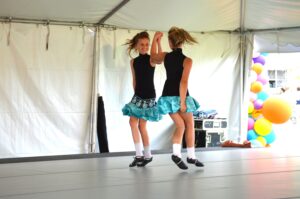
A duo of Driscoll dancers performs at Future Stages Festival | Photo by Sara Unrein
After performing at Future Stages Festival, the Driscoll dancers felt even more confident that they had made the right decision. They were delighted in the activities and fascinated by the other talented performers. Going backstage at the Kauffman Center gave the dancers an authentic, professional experience.
The youth at the Driscoll School of Irish Dance are enthusiastic about sharing – from their talents to funds.
As a non-profit organization, the Kauffman Center hopes that the Driscoll Dancers will be a catalyst not only for artistic achievement, but for generosity. Unexpected and routine support provides vibrancy to the Kauffman Center’s mission and makes free community events like Future Stages Festival possible.
If you are as inspired by the Driscoll Dancers as we are, we hope you will consider making a year-end contribution here.
Page 1 of 66